How to Hang a Hammock With Rope
Which rope to buy, how much you need, whether paracord is safe, and how to tie it without hurting the tree.
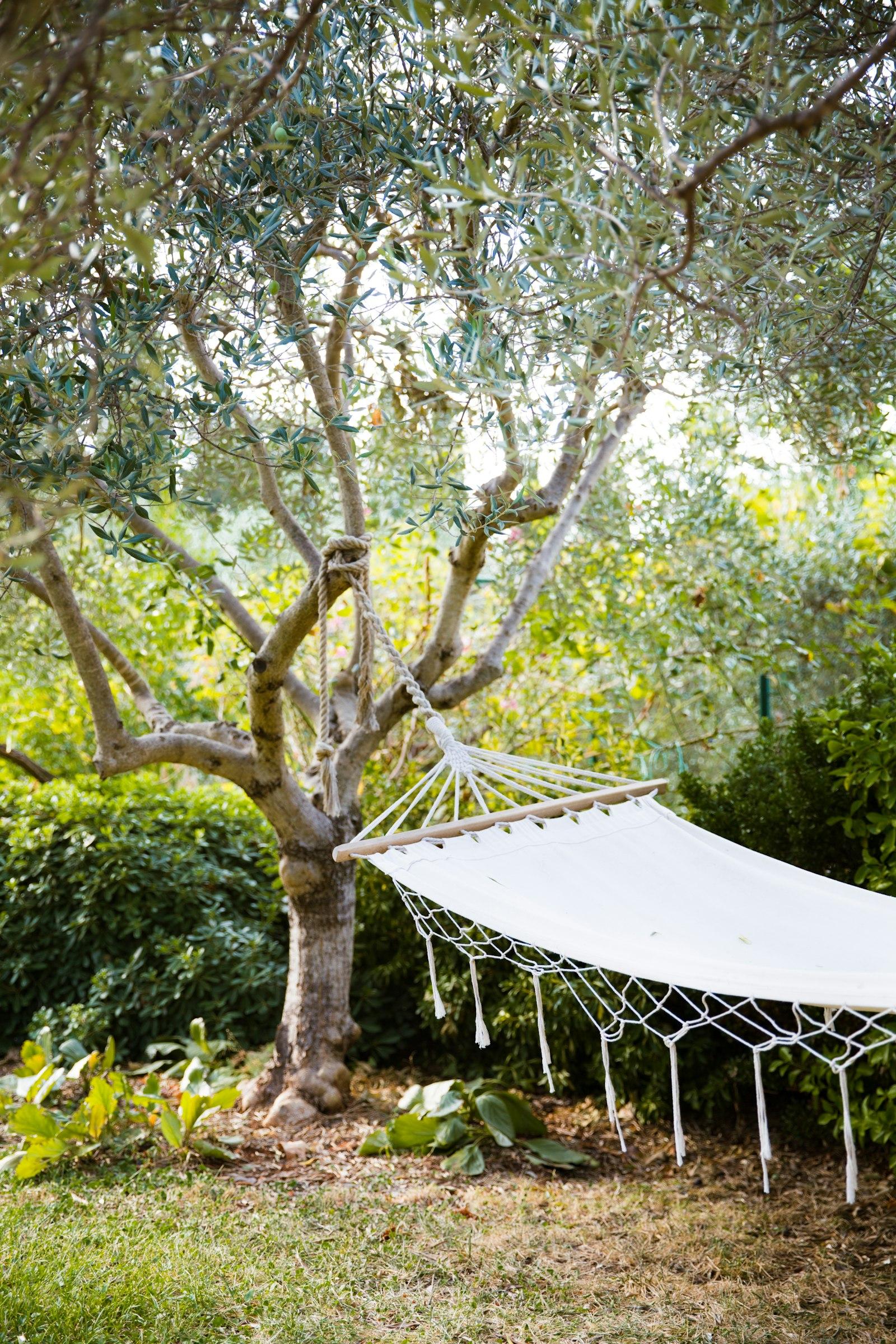
To hang a hammock with rope, wrap a strap at least 1 inch wide around each tree, then run rated polyester rope from the strap to the hammock end. Tie it with a bowline and carabiner or a becket hitch, set the line at about 30 degrees, and leave the hammock sagging like a smile. Tie rope directly to the trunk only when you have no other option.
Why rope still makes sense
Rope is cheap, easy to find in any hardware store, and goes places straps cannot: through a ring on a rope hammock, around a beam, or across a gap that is too wide for your straps. It also packs small and doubles as a clothesline or tarp line at camp.
The catch is the tree. Leave No Trace's hammock camping guidance says to use webbing 1 inch or wider around the trunk and never anything thinner. Thin rope concentrates the load into a narrow line on the bark. So the setup below uses rope for reach and adjustment, and something wide for the tree.
What is the best rope for a hammock?
| Rope material | Stretch | Sun and weather | Knot holding | Verdict |
|---|---|---|---|---|
| Polyester | Low | Good UV resistance | Good | Best all-round choice |
| Dyneema (UHMWPE) | Very low | Good | Slippery, needs care | Light, best for whoopies and ridgelines |
| Nylon | High | Fair | Good | Sags overnight, OK for short hangs |
| Polypropylene | Moderate | Breaks down in sun | Poor | Avoid for body weight |
| Cotton or manila | Moderate | Rots when wet | Good | Decor, not suspension |
Whatever material you choose, read the rated breaking strength on the label and pick something several times your body weight. Knots and a shallow hang angle both eat into that margin.
Can you hang a hammock with paracord?
You can, but it is a poor main suspension. Standard 550 paracord gets its name from a 550 lb minimum breaking strength, and it is nylon, so it stretches.
Run the numbers for a 200 lb person:
| Hang angle | Load on each end |
|---|---|
| 45 degrees | about 141 lb |
| 30 degrees | about 200 lb |
| 20 degrees | about 292 lb |
| 15 degrees | about 386 lb |
| 10 degrees | about 576 lb |
At a shallow 10 degree hang, a single strand of paracord is already past its rating before you count the strength lost in the knot or the jolt of sitting down. Paracord is fine for tarp guylines and as an emergency backup. For your body weight, use rated rope or proper hammock straps.
How long a rope do you need for a hammock?
For an 11 foot hammock between trees about 15 feet apart:
- Rope from strap to hammock: about 4 to 6 feet per side. This is the most common setup.
- Rope around the tree and to the hammock (no strap): about 8 to 10 feet per side, more for thick trunks.
- Wide gaps (20 feet or more): add 3 to 4 feet per side.
Cut a little long. You can always tie off a tail, but you cannot add length in the field. Our post on how long hammock straps should be has the geometry if you want to calculate it for your trees.
How to hang a hammock between two trees with rope
- Pick the trees. Living, at least 6 inches across, 12 to 15 feet apart, no dead branches overhead. See trees too far apart or too close.
- Put a strap on each tree. Wrap it once at about head height and pass the end through its own loop. A plain tree hugger strap works, and so does a daisy chain like the ENO Atlas.
- Tie rope to the strap. Pass the rope through the strap's end loop and tie a bowline, or tie the bowline first and clip it on with a carabiner.
- Tie rope to the hammock. For a gathered-end hammock, use a becket hitch around the bunched end. For a rope or Mayan hammock, tie a bowline through the ring or clip a carabiner to it.
- Set the angle. Adjust so the rope runs down at about 30 degrees. The empty hammock should look like a smile.
- Test. Sit in the center, bounce gently, and check that neither knot slipped. Then lie back on a diagonal.
The knots are explained step by step in the best knots for hanging a hammock.
How to hang a hammock with rope and carabiners
Carabiners make rope setups faster to take down.
- Tie a bowline loop in each end of the rope and leave the knots in place between trips.
- Clip one carabiner to the strap loop and one to the hammock.
- To adjust, untie and retie the bowline at the strap end only.
Use carabiners with a load rating stamped on the spine, and keep the gate closed and loaded along the long axis.
How to hang a hammock with just rope
Sometimes all you have is rope. If you must tie straight to a tree:
- Wrap the rope two or three times around the trunk side by side, not stacked, to spread the pressure.
- Use a round turn and two half hitches, which holds well and unties easily.
- Pad the bark with a folded cloth, a spare strap or a piece of webbing if you have it.
- Take it down when you leave.
Check local rules first. Some parks require straps of a set width, and Texas state parks require straps at least two inches wide. Our Can I hang here? tool covers rules by place.
Common rope mistakes
- Buying rope by the look of it. Check the rated breaking strength on the label. Decorative rope often has none.
- Hanging it flat to reach a far tree. That is where loads get close to three times your weight.
- Short tails. Leave at least 6 inches past every knot.
- Leaving rope out all season. Sun and rain weaken fibers over time. Store it dry and inspect it before every hang.
- Knotting around a sharp edge. Posts, rails and metal brackets can cut rope under load. Pad the edge or use a strap.
Next step
Before your next trip, add a pair of tree straps to your rope kit, and read hammock suspension systems explained to see what else you can pair with rope. For angles and height, use the calculator in how to hang a hammock.
Frequently asked questions
Can you hang a hammock with paracord?+
You can, but it is a poor choice for your body weight. 550 paracord is named for its 550 lb minimum breaking strength, and on a shallow hang one end can see nearly three times your weight before knot loss. It is nylon and stretches too. Use rated polyester rope or hammock straps instead.
What is the best rope for hanging a hammock?+
Polyester rope is the best all-round choice because it stretches little, resists sun and holds knots well. Dyneema is lighter and lower stretch but slippery to knot. Avoid polypropylene and cotton for suspension. Pick a rope rated several times your body weight.
How long of a rope do I need to hang a hammock?+
With a strap on each tree, about 4 to 6 feet of rope per side is enough for trees 15 feet apart. Tying rope around the trunk with no strap takes about 8 to 10 feet per side. Add 3 to 4 feet per side for gaps of 20 feet or more.
How do you tie a hammock to a tree with rope?+
The tree-friendly way is a wide strap around the trunk and rope from the strap to the hammock. If you must tie rope to the tree, wrap it two or three times side by side, finish with a round turn and two half hitches, pad the bark and take it down when you leave.

Find a hammock-friendly spot near you.