Trees Too Far Apart or Too Close? How to Make the Hang Work
How much space a hammock needs, and what to change when your two trees are not cooperating.
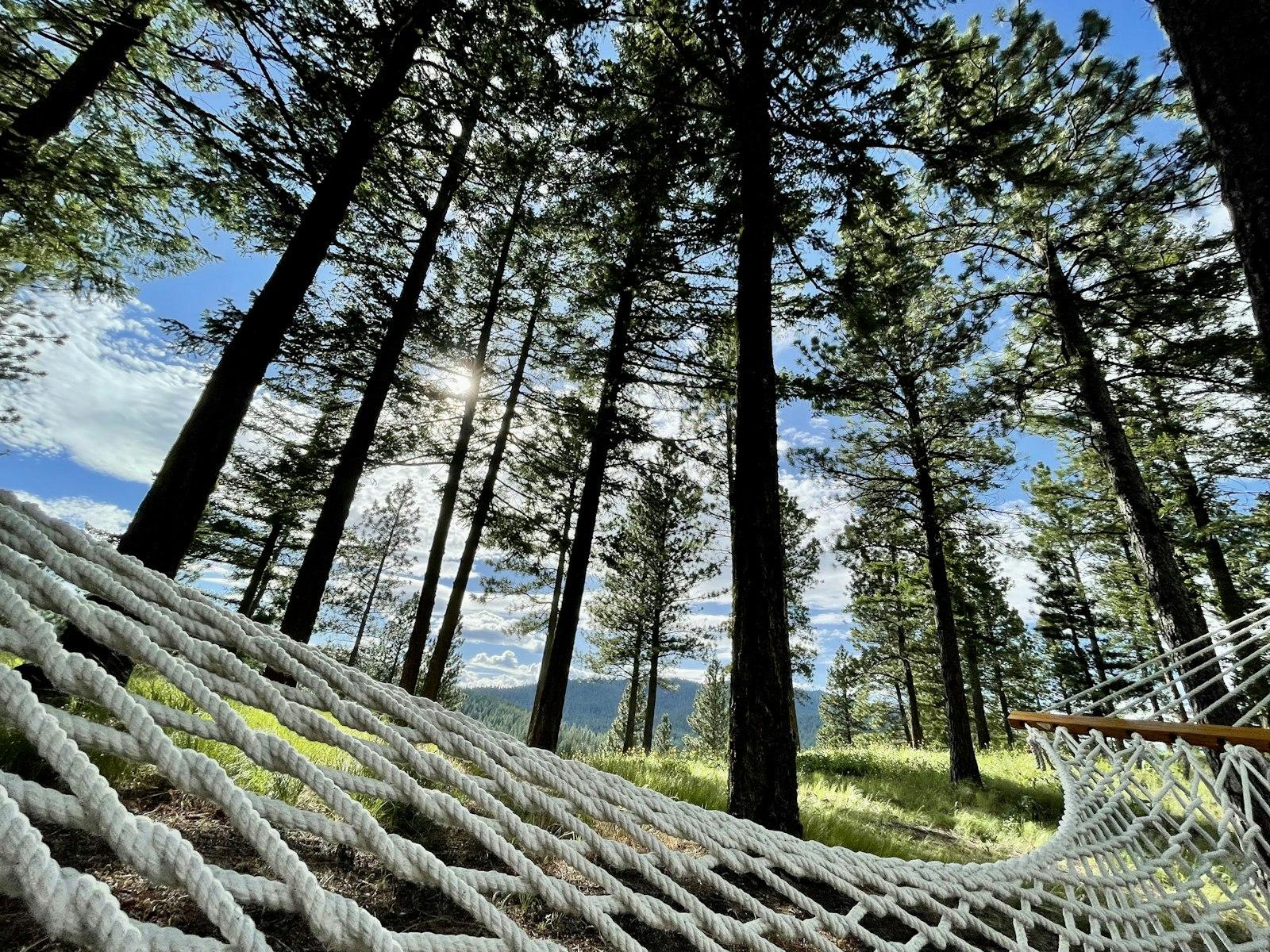
Most 9 to 11 foot hammocks hang best between trees 12 to 15 feet apart. If your trees are farther apart, add strap or suspension length and attach higher on the trunks so the line still runs down at about 30 degrees. If they are closer, attach lower, keep the sag, and expect a more seated, chair-like hang.
How much distance do you need to hang a hammock?
The working range is wider than the ideal range. Here is how spacing plays out for a typical 10 to 11 foot gathered-end hammock:
| Tree spacing | What happens | What to change |
|---|---|---|
| Under 10 ft | Hammock nearly touches both trunks, deep sag | Short hammock or hammock chair, attach low |
| 10 to 12 ft | Works, but sits deep | Attach around 5 feet, accept a seated lay |
| 12 to 15 ft | The sweet spot | Attach at about 6 feet |
| 15 to 20 ft | Works with 9 to 10 foot straps | Attach 6 to 7 feet up |
| Over 20 ft | Most straps run out | Add extensions or whoopie slings, attach higher |
Spreader bar and rope hammocks are different. They hang flatter and usually list a recommended hanging distance from the manufacturer, often longer than the hammock itself. Use that number instead of the table. For the tradeoffs, see spreader bar hammock pros and cons.
How many feet do you need to hang a hammock?
Measure two ways: the distance between trunks and the space around the hang.
- Between trunks: 12 to 15 feet for most hammocks, measured at strap height.
- Side clearance: about 3 feet on each side so you can get in without hitting a branch or a fence.
- Overhead: no dead limbs above. Leave No Trace's hammock guidance says to look up for dead branches even on a tree that looks alive.
- Below: a clear spot under where you will sit. No rocks, stumps or roots you would land on.
Pace it out if you have no tape measure. An adult walking stride is roughly 2 to 2.5 feet, so five to seven normal steps between trunks puts you in range.
How to hang a hammock between two trees far apart
Wide gaps are the more common problem at campsites. Work through these in order:
- Go higher on the trees. The farther the trees, the longer each suspension leg, and a longer leg drops more over the same 30 degree angle. Moving the straps from 6 feet to 7 or 8 feet often fixes a 20 foot gap by itself.
- Add reach. Strap extensions, whoopie slings or rated rope between strap and hammock each add a few feet. Details in how long hammock straps should be.
- Do not pull it flat to make it reach. A tight hammock across a wide gap is the classic way to overload straps. At 10 degrees each anchor can see almost three times your weight.
- Use a ridgeline. A structural ridgeline holds the hammock's sag constant no matter how far apart the trees are, so the extra distance goes into suspension, not into flattening the hammock.
A quick sanity check: after you sit down, the suspension should still look like a lazy diagonal, and your seat should be 16 to 20 inches off the ground.
Trees too close for a hammock
Close trees are harder to fix because you cannot shorten a hammock in the field. A few things help:
- Attach low. On trees 10 feet apart, try straps around 4 to 5 feet up. You want the hammock to clear the ground once loaded.
- Choke up on the hammock. Some suspensions let you girth the strap closer to the gathered end, which shortens the effective length a little.
- Sit instead of lie. A deep sag between close trees makes a decent hammock chair. For sleeping, it is uncomfortable.
- Use a shorter hammock. A 9 foot hammock is easier to fit between close backyard trees than an 11 foot one.
- Use a different anchor. If one tree is perfect and the other is too close, check whether a third tree, a post or a stand gets you a better span.
What if the trees are the wrong size?
Distance is only half of it. Leave No Trace says to use living trees at least 6 inches in diameter. Some parks set a higher bar: Texas state parks require trees at least 8 inches in diameter where the strap goes, and no more than two straps on one tree, according to the Texas Parks and Wildlife park rules.
Thick trunks also eat strap length. A 24 inch tree uses about 6 feet of strap just to wrap once, so a 9 foot strap leaves only 3 feet of reach. Our best trees for a hammock post covers species and bark.
No good trees at all?
Sometimes the honest answer is that the site will not work. Options:
- A freestanding stand, which needs no trees and gives a repeatable hang every time. Our hammocks with stands list covers frames such as the LISS GO Hammock and standalone stands like the Vivere universal steel stand.
- Posts, a porch or a vehicle. See how to hang a hammock without trees.
- A different site. Find a hang lists spots with trees that work.
A quick field method for any spacing
When you get to a site and are not sure the trees will work, try this before unpacking everything:
- Pace the gap between the trunks.
- Under 10 feet: look for another pair or plan to sit, not sleep.
- 10 to 20 feet: hang the straps at about 6 feet, clip in and sit.
- Over 20 feet: start the straps at 7 to 8 feet and add your extension right away.
- Sit down and check two things. Is your seat 16 to 20 inches off the ground? Do the straps run down at roughly 30 degrees?
- If the seat is too low, move both straps up. If the angle is flat, add length or move the straps closer to the hammock.
It takes about five minutes and saves you from discovering the problem after dark.
Next step
Before your next trip, check the trees and the rules with Can I hang here?, and bring 2 to 4 feet of extra reach in case the trees are wider than you hoped.
Frequently asked questions
How far apart should trees be for a hammock?+
For most 9 to 11 foot gathered-end hammocks, 12 to 15 feet is ideal. You can make 10 to 20 feet work by moving the straps up or down the trunks and adding suspension length. Spreader bar hammocks need the hanging distance listed by their manufacturer.
How do you hang a hammock between two trees that are far apart?+
Attach the straps higher on both trunks, then add reach with strap extensions, whoopie slings or rated rope between strap and hammock. Keep a 30 degree angle instead of pulling the hammock flat, which can nearly triple the load on each strap.
What if my trees are too close for a hammock?+
Attach the straps lower, around 4 to 5 feet on trees about 10 feet apart, and accept a deeper, more seated lay. A shorter hammock or a hammock chair fits close trees better. For sleeping, look for a wider pair of trees or use a stand.
How much space do you need for a hammock?+
Plan on 12 to 15 feet between anchors for most hammocks, about 3 feet of clearance on each side, nothing hard on the ground below and no dead branches overhead. Freestanding stands need roughly their own footprint plus room to climb in.

Find a hammock-friendly spot near you.