How to Use Hammock Straps (With and Without Loops)
Daisy-chain straps, plain webbing and ultralight cord all go on the tree the same way. The difference is how you connect the hammock.
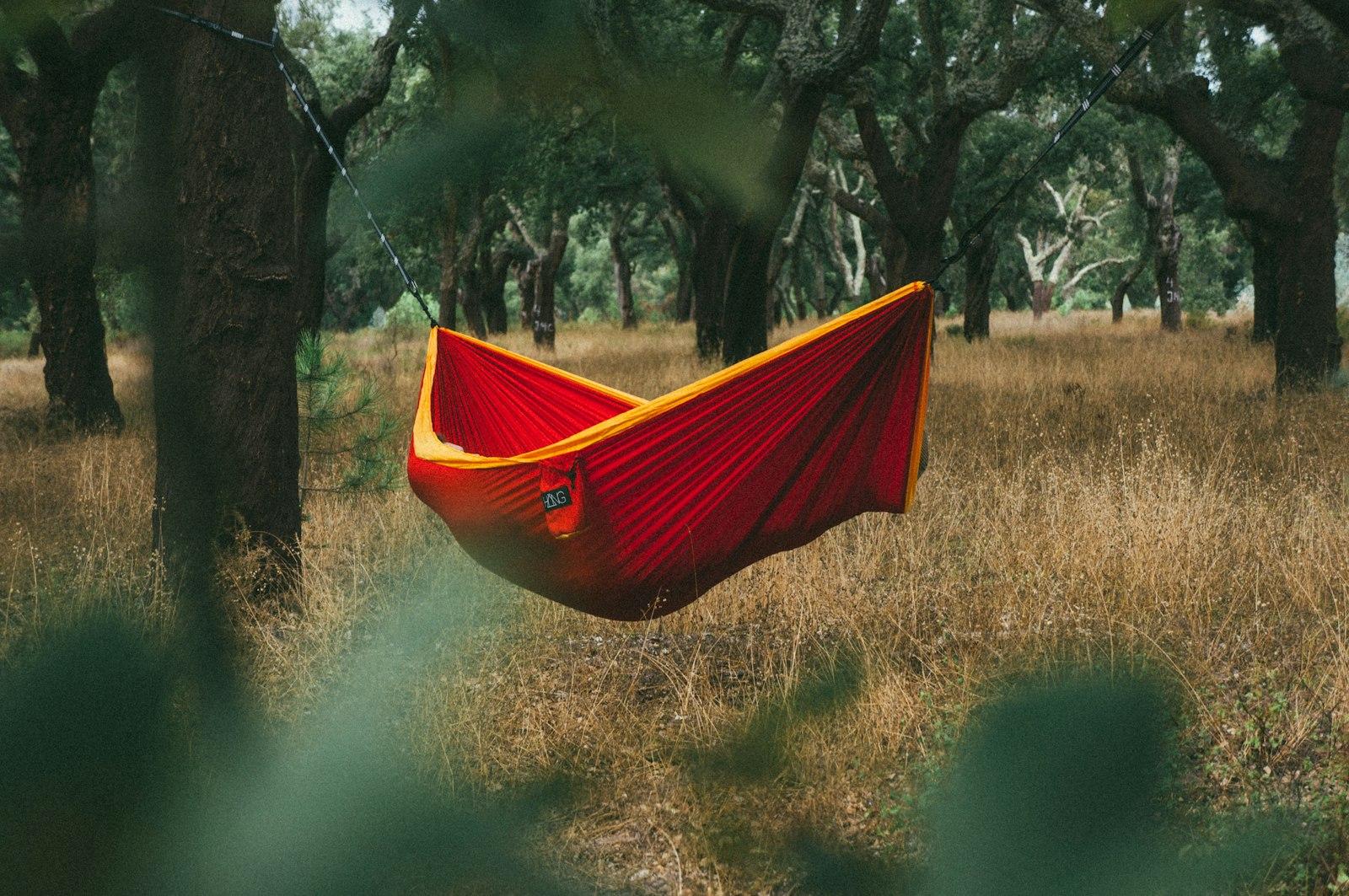
To use hammock straps, wrap each strap once around a healthy tree at about head height, pass the end through the loop on the other end, and pull it snug. Then clip your hammock's carabiner into a loop on the strap so the line runs down at roughly 30 degrees. Straps without loops need a buckle, a toggle or a knot to connect.
How do hammock straps work?
A hammock strap is a band of flat webbing that does two jobs. It spreads the load across a wide patch of bark, and it gives you an adjustable attachment point so you can set the hang without retying anything.
Most straps sold today use one of three designs:
| Strap type | How you adjust | Example from our gear pages |
|---|---|---|
| Daisy chain | Clip a carabiner into any of the sewn loops | ENO Atlas, Kammok Python 10 |
| Webbing plus cord | Slide an adjustable cord section | ENO Helios |
| Plain webbing (no loops) | Buckle, toggle or knot | Generic tree huggers |
The width is the part to get right. Leave No Trace's hammock camping guide says 1 inch or wider, and some parks ask for more. The Atlas and Python both taper from 1.5 inches at the tree to 0.75 inch at the hammock end.
How to put hammock straps on a tree
This step is the same for nearly every strap:
- Pick two living trees at least 6 inches across, with no dead branches overhead. Check the distance first: 12 to 15 feet apart is the sweet spot.
- Hold the strap at about head height, roughly 6 feet up for trees 12 to 15 feet apart.
- Wrap it around the trunk once. Not twice. Leave No Trace specifically warns against multiple wraps and tight hangs because they twist and crush the bark.
- Feed the free end through the loop at the other end and pull it snug against the bark.
- Let the free end hang toward the other tree. Repeat on the second tree at the same height.
Keep the strap flat against the bark without twists. A twisted strap concentrates pressure into a narrower band, which defeats the point of a wide strap.
How to use ENO hammock straps
The ENO Atlas is the strap most people are asking about, and it is a daisy chain: 9 feet per strap with a no-knot daisy chain, per our Atlas gear page.
- Wrap the Atlas around the tree and feed the tail through the end loop.
- Pull the strap tight to the tree.
- Clip the hammock's carabiner into the loop that gives you a 30 degree angle. Start around the middle of the chain, then move up or down.
- Sit down in the center. If your butt touches the ground, move both carabiners one or two loops closer to the trees.
The Helios works differently. It has a short webbing section for the tree and a cord section with a Microtune adjuster, so you set the length by sliding the cord rather than picking a loop. It saves weight (4.3 oz versus 9 oz for the Atlas) at the cost of a lower 300 lb rating.
How to use hammock straps without loops
Plain webbing straps, often sold as tree huggers or tree savers, have a sewn eye at each end and nothing in between. You have four common ways to connect:
- Whoopie sling. Girth the strap to the tree, then run an adjustable Dyneema whoopie sling from the strap's end loop to the hammock. Light and very adjustable. Explained in hammock suspension systems.
- Cinch buckle. A metal buckle on the hammock end grips the webbing. Thread the strap through the buckle, pull to length, and the load locks it.
- Marlinspike toggle. Tie a marlinspike hitch in the webbing or in a rope from the hammock and lock it with a strong toggle.
- Rope and a knot. Tie rope from the strap's end eye to the hammock with a becket hitch. See the best knots for a hammock.
What does not work well: tying the webbing itself in a knot around the tree. It is hard to undo once loaded and puts uneven pressure on the bark.
Hammock straps with carabiners: what to check
Carabiners are where small mistakes happen.
- Use climbing-rated or hammock-rated carabiners with a load rating stamped on the spine. Keychain carabiners are not built for body weight.
- Load the carabiner along its long axis, not across the gate.
- Make sure the gate is fully closed after clipping. A strap loop trapped in the gate opening is a common way for a hang to fail.
- If your hammock uses a toggle instead of carabiners, you will need to buy carabiners separately. Our Atlas gear page flags this as a watchout.
Common strap mistakes
- Hanging too tight. The most common one. Flat suspension multiplies the force on the straps and the trees. Aim for a smile-shaped sag.
- Uneven heights. If one strap sits a foot higher, you slide toward the low end. Match the loop counts on both sides, then adjust.
- Wrapping twice "for grip." It does not add safety and it is harder on the tree.
- Leaving straps up all week. Take them down when you leave camp so bark can recover and animals do not get tangled.
Can you leave hammock straps on a tree?
For an afternoon, yes. For days or weeks, it is a bad habit. Leave No Trace recommends keeping the time your hammock is set up short and taking it down whenever you leave camp, so animals and small children do not get tangled in it.
Long-term straps also hold moisture against the bark and slowly compress it, especially on thin-barked trees. At home, a better plan is to take the straps down after each use or switch to posts or a stand for a permanent spot. See do hammock straps hurt trees for more on bark damage.
How to take hammock straps down
Packing up is quick if you do it in order:
- Get out of the hammock and unclip the carabiners from both straps.
- Pull the strap's free end back through its loop and unwrap it from the trunk.
- Shake off bark, sap and dirt. Wet straps should dry before long storage.
- Daisy-chain the strap on itself (loop it through its own loops) so it does not tangle in the bag.
- Check the stitching and webbing for fraying or sun fade every few trips. Replace straps that look worn rather than guessing.
Next step
If you are buying, compare strap length and rating side by side in our best tree straps list or with the gear compare tool. Then check how long your hammock straps should be for the trees you hang on most.
Frequently asked questions
How do you put hammock straps on a tree?+
Wrap the strap once around the trunk at about head height, feed the free end through the loop at the other end and pull it snug and flat against the bark. Do the same on the second tree at the same height, then clip the hammock to a loop on each strap.
How do you use hammock straps without loops?+
Girth the plain strap to the tree, then connect the hammock to its end eye with a whoopie sling, a cinch buckle, a marlinspike toggle or a rope tied with a becket hitch. Each gives you adjustment that a loopless strap cannot. Avoid knotting the webbing around the tree.
Which loop do I use on ENO Atlas straps?+
Start around the middle of the daisy chain and clip in so the strap runs down to the hammock at about 30 degrees. Sit in the center to test. If you sink too low, move each carabiner one or two loops closer to the trees. Match the loops on both sides.
Do hammock straps come with carabiners?+
Usually not. Most tree straps, including the ENO Atlas, ship without carabiners because many hammocks already include them. If your hammock uses a toggle or a plain loop, buy load-rated carabiners, check the stamped rating before you hang, and skip keychain carabiners.


Find a hammock-friendly spot near you.