Do Hammocks Hurt Trees? How to Hang Without Damage
What actually happens under the strap, which trees to skip, and the setup that keeps bark intact.
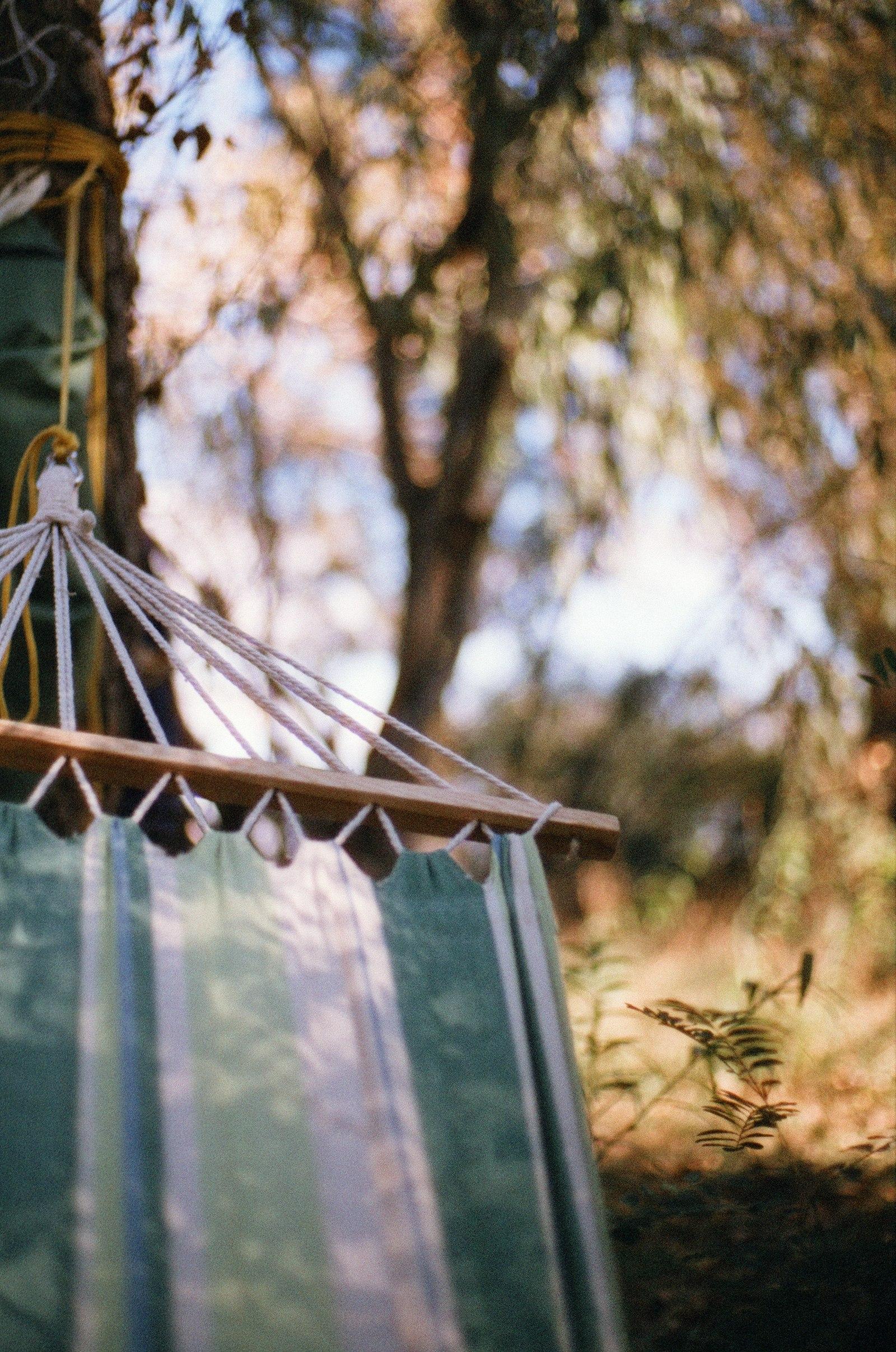
Hammock straps can hurt trees, but wide webbing used the right way rarely does much harm. The damage comes from thin rope or cord that cuts into bark, from wrapping and cinching too tight, and from hanging on the same tree day after day. Use straps 1 inch or wider, a single loose wrap and healthy trees at least 6 inches across.
That is the short version. The longer version matters, because the trees you hang from today are the ones the next person wants to hang from next year.
How do hammocks damage trees?
Bark looks tough, but the important part of a tree trunk is thin and soft. Just under the outer bark is the phloem, the inner bark that carries the tree's food down toward the roots. Under that is the cambium, the layer that makes the trunk thicker each year. If damage goes all the way around the trunk, it is called girdling. (New Mexico State University Extension)
A hammock with a person in it pulls hard on its anchors, and all that load sits where the strap meets the bark. A thin cord focuses the force on a narrow line, so it can crush or saw into the inner bark as the hammock swings. A wide strap spreads the same force over more bark.
Leave No Trace says a tight hang can cause twisting and squishing of the bark and phloem, and it recommends webbing straps 1 inch or wider that go around the tree to limit girdling. (Leave No Trace hammock guidelines, 2025)
Can a hammock kill a tree?
One careful hang with wide straps is very unlikely to kill a healthy tree. The risk climbs when the damage adds up.
- Repeated use. Campsite and campus trees get hung on every day. Penn State's grounds team has asked people not to attach hammocks or slacklines to campus trees because it can harm the bark and the inner cambium layers, causing long term health problems. (Penn State)
- Damage all the way around. A rope that saws through bark on every side starts to look like girdling, which cuts off the food supply to the roots.
- Small or weak trees. A thin trunk bends under load, and roots in wet soil can shift.
- Trampled roots. Heavy foot traffic around one tree packs the soil over its roots.
Nobody we found has published a controlled study measuring hammock damage strap by strap, so be careful with anyone who quotes exact numbers. What the parks agree on is the direction: wider straps, fewer wraps, bigger trees and less reuse.
Are hammock straps bad for trees?
Straps are the tree friendly option. Rope and cord are the problem. Here is how common attachment methods compare, along with what some parks require.
| Attachment | Risk to bark | What the rules say |
|---|---|---|
| Rope or paracord | High. Narrow and saws as it moves | Wisconsin state parks: no rope or paracord |
| Strap under 1 inch | Moderate | Below the minimum in Glacier and Wisconsin |
| Webbing 1 inch or wider | Low with a loose wrap | Leave No Trace minimum; Glacier requires 1 inch or more |
| Webbing 2 inches plus padding | Lowest | Three Rivers Park District requires 2 inch webbing and bark protection |
| Chains, wire, nails, screws | Severe | Banned in Sequoia and Kings Canyon, Acadia and Wisconsin |
Sources: Wisconsin DNR, Glacier compendium, Three Rivers Park District, Sequoia and Kings Canyon campground regulations, Camping in Acadia.
If your hammock came with thin rope, swap it for a pair of tree straps. Our guide to how to use hammock straps walks through the setup.
Which trees should you use and which should you skip?
Tree choice does as much as strap choice.
Use:
- Living trees with a solid trunk. Leave No Trace suggests at least 6 inches in diameter, preferably with hard bark and no lichen.
- The thickest part of the trunk, not a branch.
- Bigger trees where the rules ask for them. Great Smoky Mountains requires 10 inches in diameter with padding, Three Rivers Park District requires 12 inches, and Wisconsin requires more than 1 foot. (Smokies campground regulations, NPS)
Skip:
- Dead trees or trees with dead branches overhead. They can fall.
- Trees that bend when you load them. Three Rivers says if the tree sways, it is too small.
- Trees in wet ground, which Leave No Trace warns can uproot more easily.
- Oaks where the rules say so. Wisconsin bans hammocks on oak trees, and Yosemite keeps slacklines off oaks.
- Special trees such as Joshua trees, which their park protects completely.
More on picking anchors in the best trees for a hammock.
How do you hang a hammock without damaging the tree?
This setup covers almost every case.
- Pick two healthy trees about 12 to 15 feet apart, thick enough for the local rules.
- Wrap each strap around the trunk once, flat against the bark, with no twists.
- Pass the end through its loop or connector as the maker intends. No knots and no multiple wraps, which Leave No Trace says can squeeze the bark.
- Add padding if the bark is soft or the park asks for it. A tree saver strap or a folded cloth works.
- Keep a loose hang. The straps should hang slightly before you get in.
- Hang less than 5 feet off the ground, which also keeps you off higher branches.
- Take it down when you leave camp so wildlife and kids do not get tangled.
- If you camp for several nights, avoid wearing the same spot on the same tree for days on end.
Our how to hang a hammock guide covers angles and height in more detail.
How can you tell a tree is being damaged?
Look at the bark where straps usually go, at about chest to head height. Popular campsite trees tell the story fast.
- Polished or rubbed bark. A smooth band around the trunk means straps have been sliding on it.
- Exposed light wood. If you can see pale wood under the bark, the protective layers are gone in that spot. Pick a different tree.
- Rope grooves. Thin lines cut into the bark come from cord, not wide straps.
- Sap or weeping. Fresh wounds on some trees ooze sap.
- Bare, packed soil around the base. Heavy traffic is compacting the roots.
If a tree shows any of these, give it a rest. Hang on a healthier neighbor or move to a different site. If the bark looks soft, add padding under the strap. Wisconsin already requires padding around the trunk in its state parks, and the Smokies ask for adequate padding too.
Does hammocking damage the ground too?
It can. A hammock sits over whatever is under it, and you walk in and out of the same spot. Leave No Trace suggests setting up at least 200 feet from water to protect riparian plants, using established campsites, and checking the ground for sensitive plants before you hang.
Many parks say the same thing in their own words. Glacier wants hammocks over bare, durable surfaces inside the campsite, and Rocky Mountain says they may not overhang vegetation.
If there are no good trees, use a stand or a built anchor. A freestanding frame protects trees completely and works on lawns, decks and beaches. See hammocks with stands or read do you need a hammock stand.
Next step
Check the rules for your next spot on Can I Hang Here, then read hammock safety and Leave No Trace before you go.
Frequently asked questions
Are hammocks bad for trees?+
Not when they are hung well. Wide webbing straps on healthy trees, wrapped once and hung loosely, cause little harm. Thin rope, tight multiple wraps, small trees and daily reuse of the same tree cause most of the damage. That is why many parks require straps at least 1 inch wide and minimum trunk sizes.
Can a hammock kill a tree?+
One careful hang is very unlikely to kill a healthy tree. Damage builds up when rope saws through the bark, when wraps squeeze it all the way around, or when the same tree is used every day. Severe damage around the whole trunk is girdling, which cuts off food to the roots and can kill a tree.
Does hammocking damage trees?+
It can damage bark and the thin living layers underneath, especially with narrow rope or heavy reuse. Leave No Trace recommends straps 1 inch or wider, a single loose wrap, living trees at least 6 inches across, and hanging under 5 feet high. Following those habits and local park rules keeps damage low.
How wide should hammock straps be to protect trees?+
At least 1 inch. Leave No Trace and Glacier National Park both set 1 inch as the minimum, and Wisconsin state parks require 1 inch with padding. Some park systems ask for more, like Three Rivers Park District in Minnesota, which requires 2 inch flat webbing plus bark protection. Wider straps spread the load over more bark.
Can you use rope to hang a hammock on a tree?+
It is better not to. Rope and paracord are narrow, so they concentrate the load and can saw into bark as the hammock moves. Wisconsin state parks ban rope and paracord for this reason, and Three Rivers Park District does not allow rope for attachment. Use wide webbing straps around the tree and connect your rope or hammock to those.
Find a hammock-friendly spot near you.