Hammock vs Bivy: Which Shelter Is Right for You?
Two minimalist ways to sleep outside. How they compare on weight, weather, comfort and where you can actually set them up.
A bivy is a waterproof sack that wraps your sleeping bag and pad on the ground, so it works anywhere you can lie flat, including above treeline. A hammock with a tarp needs two trees but keeps you off rocks, roots and wet ground, and most people find it more comfortable. Pick a bivy for open terrain and minimal weight. Pick a hammock for forests and better sleep.
What is a bivy?
A bivy (short for bivouac sack) is a minimal shelter shaped like a sleeping bag cover. You slide your pad and bag inside, and the shell keeps off rain, dew and wind. Some have a small hoop or pole over the face and a mesh window for bugs. Many minimalist bivy sacks weigh around a pound, but check the listed weight of the model you are looking at.
It is the smallest shelter you can carry. It is also the most confined: there is no room to sit up, change clothes or store gear inside. Your pack sleeps outside, under a vestibule if you bring a small tarp, or in a trash bag if you do not.
Bivies come in two broad types. Simple sacks are a shell and nothing else, used mostly by climbers and fast hikers as an emergency or bare-minimum shelter. Hooped bivies add a short pole that lifts the fabric off your face and gives a little headroom. The hooped kind is easier to live with for more than one night.
Hammock vs bivy: side by side
| Hammock and tarp | Bivy | |
|---|---|---|
| Needs | Two trees or anchors 12 to 15 ft apart | A flat spot the length of your body |
| Above treeline, desert, beach | No (without a stand) | Yes |
| Rocky, sloped or wet ground | Not a problem | A real problem |
| Comfort | High for most back sleepers | Same as ground sleeping on your pad |
| Rain | Tarp overhead, open sides, room to cook and change | Sealed sack, little room, condensation |
| Bugs | Needs a bug net | Mesh panel on some models |
| Insulation | Underquilt or pad needed below | Pad needed below |
| Living space | Hammock doubles as a chair, tarp covers gear | None |
Weight: are hammocks lighter than tents and bivies?
A full hammock system is usually lighter than a heavy tent, about the same as a one-person backpacking tent and pad, and heavier than a bivy plus pad. The hammock vs tent guide covers the tent side.
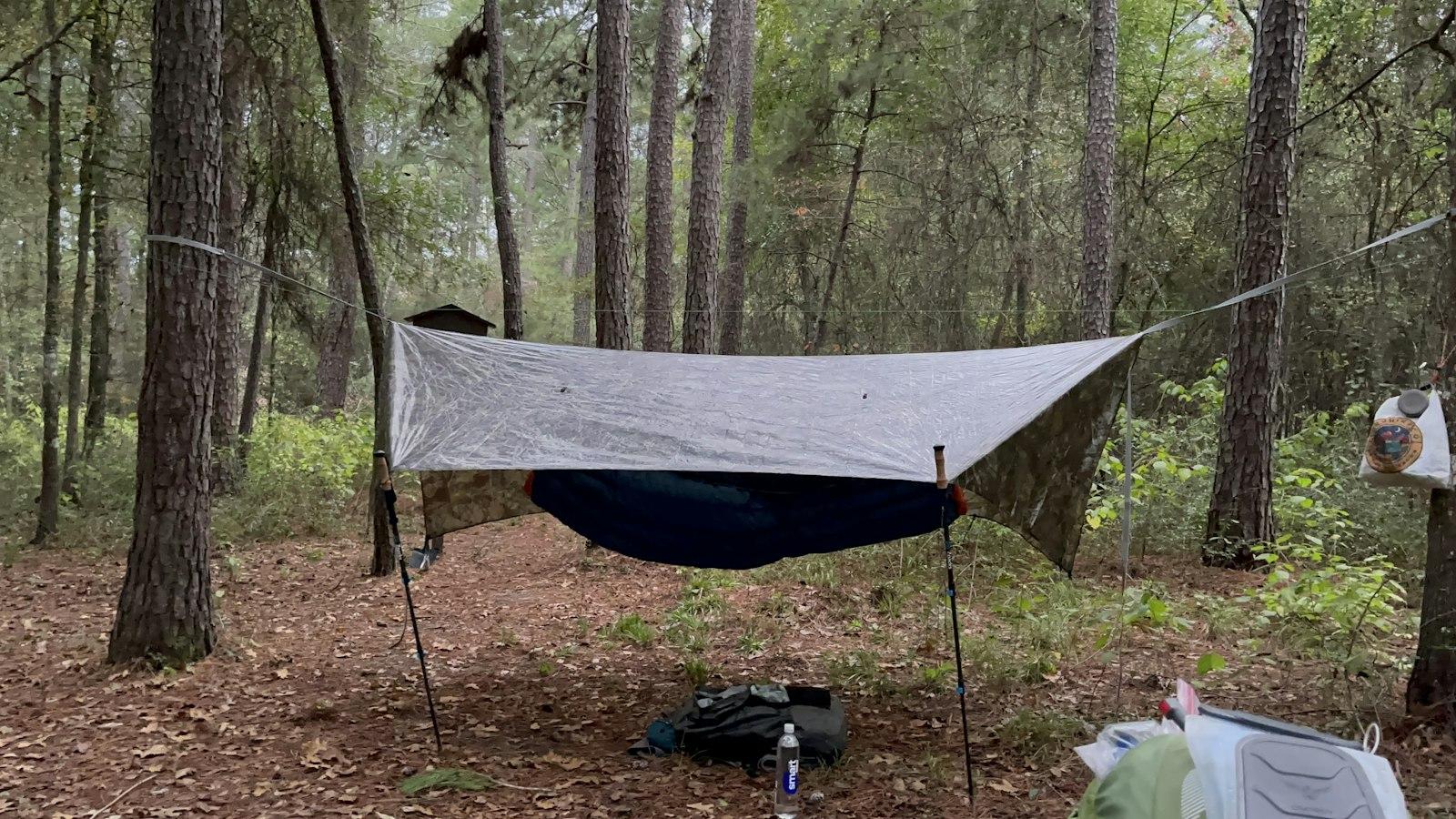
Here is a real hammock system built from specs in our gear database:
| Item | Listed weight |
|---|---|
| Warbonnet Blackbird XLC, single layer with net top | 19 oz |
| ENO Helios straps | 4.3 oz |
| Kammok Kuhli tarp, with stakes and guylines | 20.5 oz |
| Hammock Gear Incubator 20 underquilt (one listed configuration) | 25.6 oz |
| Total | about 69 oz (4.3 lb) |
That covers shelter, bug protection, rain cover and insulation below you. Note the Blackbird's base price ships with continuous loops only, so its usable suspension is an add-on. A bivy setup needs a bivy, a pad and often a small tarp in heavy rain. On paper the bivy wins on weight. In practice the gap depends on which pad and which tarp you carry.
All-in-one hammock kits are heavier. The Kammok Mantis lists a total packed weight of 3.06 lb with fly and straps, and the Hennessy Expedition Zip lists 44 oz. They trade a few ounces for an easier first setup.
One more point: the hammock system above has no sleeping pad. If you use a pad in a bivy, count it. If you use a pad in a hammock instead of an underquilt, count that too. Compare full systems, not single items.
Comfort
This is where hammocks pull ahead for most people. In a bivy, you are on the ground. Comfort comes down to your pad and how flat the site is. A root under your hip at 2 a.m. stays there.
In a hammock hung with sag and lain on the diagonal, there is nothing under you but fabric. Many tent and ground sleepers report their first good night in a hammock surprised them. Some never adapt, mostly stomach sleepers, and they tend to go back to the ground.
Bivies also feel closed in. Some people sleep fine with the fabric a few inches from their face. Others find it claustrophobic, especially with the hood zipped in rain. A hammock under a tarp feels open by comparison.
Weather
Rain: A hammock tarp gives you a dry room. You can sit under it, cook near it and pack in the dry. A bivy keeps rain off your bag, but getting in and out in a downpour is wet, and many bivies trap condensation inside on cold, humid nights. Read hammock camping in the rain for tarp pitches that hold up.
Wind: A bivy lies low and shrugs off wind. It also hides well, which is why some hikers like it for tight, unofficial-looking sites. Only camp where camping is allowed, whichever shelter you carry. A hammock sits in moving air, so pitch the tarp low on the windward side.
Cold: Both need insulation under you. A bivy adds a little warmth by blocking wind around your bag. A hammock needs an underquilt or pad, since moving air carries heat away from below. See are hammocks colder than tents.
Where you can use each
- Forests of the eastern US, the Pacific Northwest, the Ozarks: hammock territory. Trees everywhere, flat ground rare. Browse best forest hangs.
- Above treeline, desert and open coast: bivy territory. No trees, plenty of flat ground.
- Mixed routes: some hikers carry a hammock that can pitch on the ground as a bivy in a pinch. It works, but it is a compromise both ways.
Rules matter too. Some parks restrict what you can attach to trees. Check Can I Hang Here before a trip.
Hammock and tarp vs tent vs bivy: who should pick what
- You want the lightest possible shelter and camp in open terrain: bivy.
- You camp under trees and want the best sleep: hammock and tarp.
- You want space, privacy and a partner beside you: tent.
- You are new and want an easy first trip: an all-in-one hammock kit or a tent. A bivy has the steepest learning curve for comfort.
Common mistakes with each
- Bivy: pitching in a low spot where water pools, and zipping fully closed on humid nights so condensation soaks the bag.
- Hammock: hanging too tight, skipping insulation below and pitching the tarp too high. Our hammock camping mistakes post covers the rest.
Next step
If trees are part of your route, build your setup from the best ultralight hammocks and the best rain tarps, then plan the trip with the trip planner.
Frequently asked questions
Is a hammock or bivy better for backpacking?+
It depends on the terrain. A hammock with a tarp is better in forests because it keeps you off rocks, roots and wet ground and most people sleep better in it. A bivy is better above treeline, in deserts and on open coast, where there are no trees, and it is usually the lighter option.
Are hammocks lighter than tents?+
A full hammock system with straps, bug net, tarp and underquilt weighs about the same as a one-person backpacking tent and pad, and less than most two-person tents. A hammock on its own is light, often 1 to 2 pounds, but insulation and a tarp add most of the weight.
Is a hammock and tarp better than a tent?+
In forests, many campers prefer a hammock and tarp because any two trees work and the ground does not matter. A tent is better in treeless places, in deep cold, for couples and in parks that restrict hanging from trees. Plenty of people own both and choose by trip.
What is a bivy sack?+
A bivy sack is a minimal waterproof shelter shaped like a sleeping bag cover. You slide your pad and bag inside and the shell keeps off rain, dew and wind. Some models add a small pole over your face and a mesh window. It is very small and light, with no room to sit up.
Find a hammock-friendly spot near you.