Hammock Weight Limits: How Much Can a Hammock Hold?
The number on the tag is only part of the story. Straps, carabiners, trees and the hang angle all decide how much load your setup can take.

A hammock weight limit is the maximum static load the maker says the hammock can carry. Most camping hammocks list 250 to 500 lb (about 113 to 227 kg), and most backyard double hammocks list around 400 to 450 lb. Your real limit is the lowest-rated part of the whole setup: hammock, straps, carabiners, stand or anchors. Stay well under it.
Typical hammock weight limits
Here are listed capacities from hammocks in our gear data. These come from maker pages.
| Hammock | Type | Listed capacity |
|---|---|---|
| Hennessy Expedition Zip | Camping, all-in-one | 250 lb |
| Haven Tent | Lay-flat camping | 285 lb |
| ENO SuperSub | Ultralight | 300 lb |
| Warbonnet Blackbird XLC (single layer) | Camping | 250 lb comfort, 300 lb max |
| LISS GO Hammock | Freestanding with frame | 310 lb |
| ENO SingleNest and DoubleNest | Camping and backyard | 400 lb |
| Yellow Leaf Classic Double | Backyard woven | 400 lb |
| Vivere Double Cotton with Stand | Backyard with stand | 450 lb |
| Pawleys Island Large Rope | Backyard rope | 450 lb |
| Kammok Roo Double | Camping | 500 lb |
Notice that "double" does not always mean a higher rating. The ENO SingleNest and DoubleNest share the same 400 lb limit. The difference is width.
Your real limit is the weakest link
A hammock setup is a chain. The safe limit is the lowest rating in that chain:
- Hammock body. The fabric and the end channels or loops.
- Straps. The ENO Atlas lists 400 lb. Kammok Python 10 lists 500 lb. The ultralight ENO Helios lists 300 lb.
- Carabiners and hardware. Some ship with high-strength carabiners, others with light ones that are not meant for climbing loads.
- Stand. The Vivere Universal Steel Stand lists 450 lb. The ENO SoloPod lists 400 lb.
- Anchors. Trees, posts, beams or wall mounts. These are often the weakest part indoors.
Pair a 500 lb hammock with 300 lb straps and you have a 300 lb setup.
Some makers also list a comfort range below the max. Warbonnet's single-layer Blackbird XLC, for example, gives 250 lb as the comfort range and 300 lb as max load. Use the comfort figure when it exists.
Why hang angle changes the load on anchors
The hammock rating covers your weight on the fabric. Your trees and straps see more than that, depending on the angle of the suspension.
At about 30 degrees from horizontal, each anchor carries roughly your body weight. Pull the suspension flatter, around 10 degrees, and the force on each anchor rises to almost three times your weight. That is basic physics: the flatter the line, the more tension it takes to hold the same load.
So a tight, flat hang can push straps and anchors past their rating even if you are well under the hammock's limit. Our guide on how to hang a hammock explains the 30 degree rule.
Can a hammock hold two people?
Many can, if you check three things:
- Combined weight under the lowest rating. Two adults at 180 lb each add up to 360 lb, which is under 400 lb but close.
- Width. A double hammock gives two people room. A single will squeeze you both into the middle.
- Dynamic load. Two people getting in at once, bouncing or swinging adds force beyond static weight.
Many camping hammocks list 300 to 400 lb, so two average adults are near or over the limit in many models.
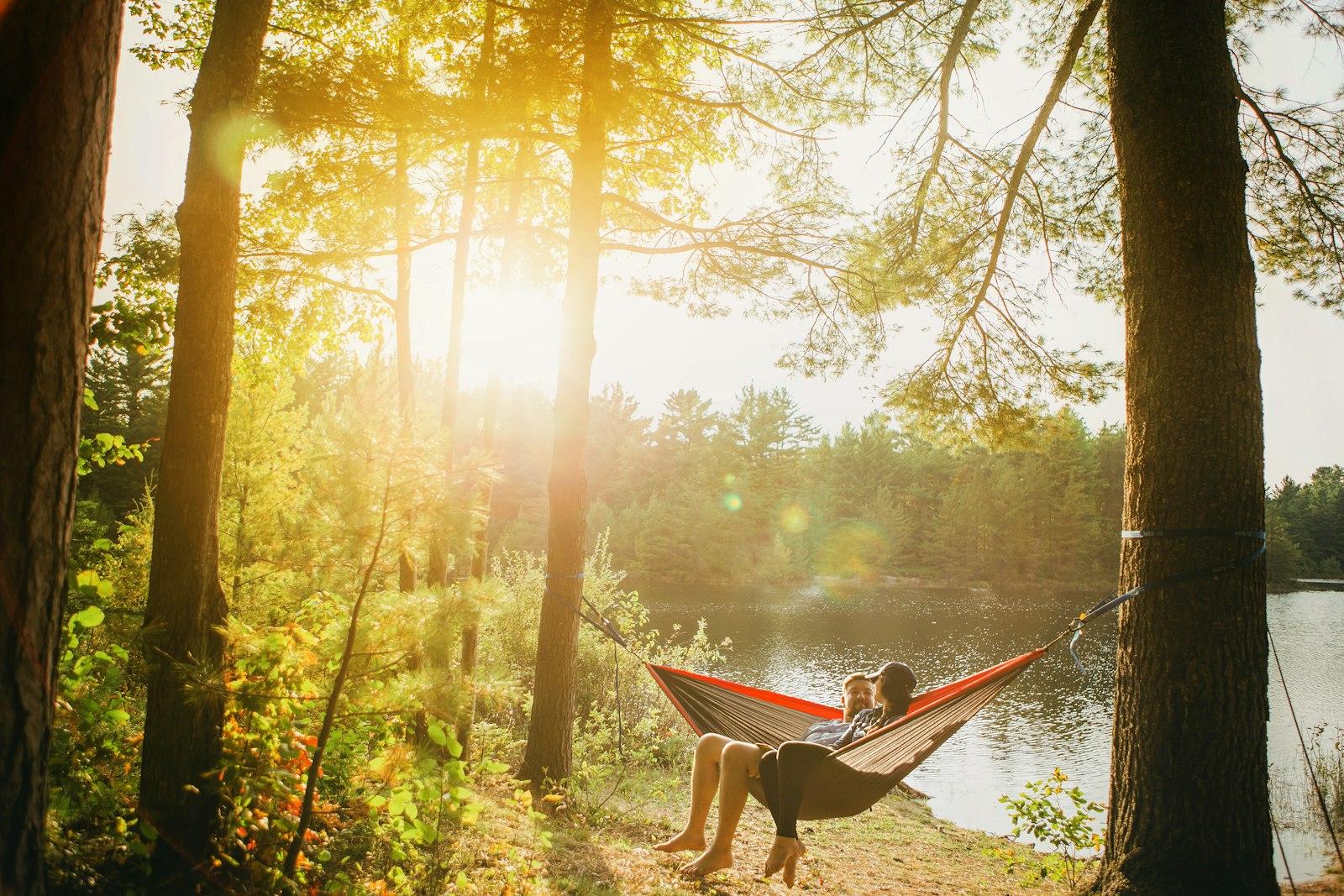
If you want to share often, look for a hammock and straps rated to 500 lb, hang lower than usual and agree on getting in and out one at a time. On a stand, check that the stand's rating covers both of you as well. For sleeping, two hammocks hung side by side or stacked on the same trees spread the load and give each person their own lay. Our single vs double hammock post covers fitting two people.
Static vs dynamic loads
Listed capacities are for a person settling in, not jumping. Dropping into a hammock, kids piling on or hard swinging all spike the load for a moment. Makers rarely publish how much margin sits between the listed capacity and the point where something breaks, so treat the number on the tag as a ceiling for calm use, not a target to load up to.
Practical rules:
- Sit down gently in the middle, then lift your legs.
- Do not let kids jump in, stand up or climb on the hammock.
- Do not swing hard on a hammock near its limit.
- Hang low, around 18 inches (46 cm) seat height, so any failure is a short drop.
Checking trees, posts and beams
The anchor is the part people check least. A hammock rated to 400 lb does nothing for you if the anchor gives way first.
Trees. Use healthy, living trees at least 6 inches (15 cm) across. Look up before you hang: dead branches overhead are a real hazard in wind. Skip trees with cracks, fungus at the base, loose bark or a lean. Use wide tree straps to protect the bark. Our guide on hammock safety and Leave No Trace covers tree choice.
Posts. A post needs to resist sideways pull, not just hold weight straight down. A freestanding fence post or a thin porch post can bend or snap under a hammock's angled load. Solid posts set deep in concrete are the usual approach. Our post on how to hang a hammock between posts goes into detail.
Beams and walls. Indoors, anchor into solid framing, not drywall, and use hardware rated well above your weight. If you are not sure what is behind the surface, ask a contractor before you hang.
Stands. Check the stand's own capacity and match the hammock length to the stand.
When to retire a hammock or straps
Capacity falls as gear ages. Replace or stop using parts that show:
- Fraying, cuts or worn spots in webbing or fabric.
- Stitching pulling out at the ends or loops.
- Faded, stiff or brittle fabric from long sun exposure.
- Bent, cracked or sticking carabiners.
- Mold that has weakened the material.
Our posts on how long hammocks last and hammock injuries and how to avoid them cover inspection in more depth.
Next step
If you need more capacity, browse big and tall hammocks and tree straps, and use the gear compare tool to match ratings across your whole setup.
Frequently asked questions
What is the average hammock weight limit?+
Most camping hammocks list between 250 and 500 lb, with 300 to 400 lb the most common range. Backyard double hammocks often list 400 to 450 lb. Always treat the lowest rating in your setup as the real limit, including straps, carabiners, stands and anchors, not just the hammock itself.
Can the average hammock hold 2 people?+
Sometimes. Two average adults often add up to 300 to 400 lb, which is near or over the limit of many camping hammocks. Check that your combined weight is under the lowest rating in the setup, choose a double width, and get in gently. For a full night, two separate hammocks are more comfortable.
How much weight can hammock straps hold?+
It depends on the strap. In our gear data, the ENO Atlas lists 400 lb, the Kammok Python 10 lists 500 lb and the ultralight ENO Helios lists 300 lb. A flat hang angle increases the force on straps, so hang at about 30 degrees and stay well under the strap rating.
What happens if you exceed a hammock's weight limit?+
The weakest part of the system can fail. That might be fabric tearing at the ends, stitching pulling out, a carabiner opening, a strap breaking or an anchor pulling loose. Even short of failure, overloading speeds up wear. Hang low so any failure is a short drop, and stay under the lowest rating.

Find a hammock-friendly spot near you.